Tour D’ Savannah's First Historic Squares
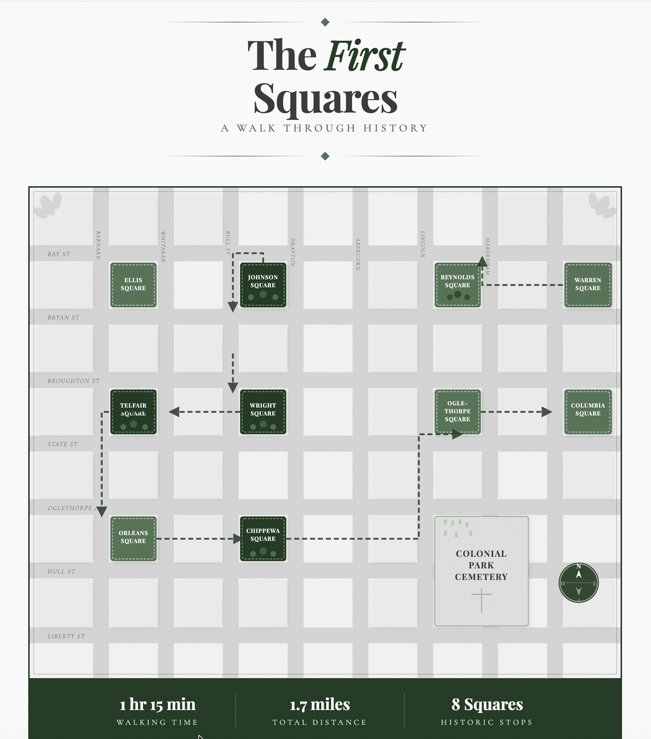
Savannah was designed around its squares — and that was entirely intentional. When General James Edward Oglethorpe laid out the city in 1733, he created a grid unlike anything in the American colonies: a repeating pattern of wards, each anchored by a central green square meant for gathering, militia drills, and community life. What began as practical urban planning became one of the world's most beloved cityscapes.
This walking tour traces the city's oldest squares — the ones that witnessed Savannah's founding, its golden age, its wars, and its revival. Comfortable shoes are encouraged. Curiosity is required.
The Squares
Johnson Square
The oldest and grandest — where Savannah began.
Johnson Square holds the distinction of being Savannah's very first square, laid out by Oglethorpe himself in 1733. Named for Robert Johnson, the colonial governor of South Carolina who helped finance Georgia's settlement, it remains the largest of the city's squares and one of its most historically charged.
At its center stands a monument to Nathanael Greene, the Revolutionary War general who was gifted a Georgia plantation after the war. The sundial that once marked the square's heart has long since been replaced by the soaring obelisk, but the spirit of civic ceremony that Greene embodied — public speeches, parades, declarations — still echoes here on summer evenings.
"This is where Savannahians gathered to hear the reading of the Declaration of Independence in August 1776 — and where they celebrated the end of the Civil War nearly a century later."
Today, the square is framed by Christ Church (Georgia's oldest congregation), two handsome 19th-century banking buildings, and the constant rustle of live oaks draped in Spanish moss. Morning light filters through the canopy in a way that makes even the most hurried visitor slow down.
Ellis Square
The market square, reborn after a long disappearance.
Ellis Square has one of the most dramatic stories in Savannah's urban history — it's the only square that was completely demolished and then resurrected. Named for Henry Ellis, Georgia's second colonial governor, it was home to the City Market for more than 150 years, a bustling hub of commerce where cotton, produce, and enslaved people were traded.
In 1954, the market was razed and replaced with a parking garage — a wound the city carried for decades. In 2010, the garage was removed and Ellis Square was painstakingly restored to its original footprint, complete with a playful splash fountain that has since become a favorite with children and parents alike.
"Adjacent to City Market, today's Ellis Square hums with outdoor dining, live music, and the kind of easy sociability that Oglethorpe surely had in mind when he designed these open-air gathering places."
Reynolds Square
Where John Wesley preached — and where Savannah's literary legacy took root.
Reynolds Square honors John Reynolds, Georgia's first royal governor, though it is best remembered for a more theological figure: John Wesley, the founder of Methodism, who served as minister to Savannah's colonists from 1736 to 1737. A bronze statue of Wesley stands at the square's center, gazing thoughtfully southward.
The square is flanked by the Olde Pink House, one of Savannah's most beloved restaurants, occupying a rose-hued Georgian mansion built in 1771 — the only colonial-era mansion still standing in the city's downtown. The building's walls seem to hold centuries of conversation, clinking glasses, and the particular warmth of Southern hospitality.
"Wesley's time in Savannah was brief and not without personal turmoil, but his influence on Georgia's spiritual life — and eventually on Protestant Christianity worldwide — was immeasurable."
Warren Square
A quieter corner, rich with residential grace.
Named for General Joseph Warren, a hero of the Battle of Bunker Hill who became one of the first prominent American officers to fall in the Revolutionary War, Warren Square is among the more tranquil stops on this tour. Tucked between Habersham and Houston Streets, it sits in a residential neighborhood that has barely changed since the 19th century.
The square is shaded by a magnificent canopy of live oaks, their branches draped in Spanish moss that sways in the coastal breeze. The surrounding townhouses — many of them now private homes and bed-and-breakfasts — are textbook examples of Savannah's Federal and Regency architectural traditions, with raised stoops, shuttered windows, and iron garden fences worn smooth by two centuries of salt air.
Warren Square rewards the visitor who lingers. Sit on a bench, listen to the city, and notice how thoroughly the trees have reclaimed this small piece of urban ground, making it almost sylvan.
Telfair Square
The cultural heart of the city — art, architecture, and ambition.
Telfair Square is named for Edward Telfair, a Georgia governor and delegate to the Continental Congress, but it owes its fame to his daughter Mary Telfair, who bequeathed the family mansion to the Georgia Historical Society upon her death in 1875 with a single condition: that it become a museum open to the public.
That mansion — the Telfair Academy of Arts and Sciences — is now the oldest public art museum in the American South, and it anchors a square that feels distinctly European in character. The Neoclassical façade, designed by William Jay, is as fine a piece of architecture as Savannah possesses. Across the square stands Trinity United Methodist Church, a stately Gothic Revival building that has anchored the neighborhood's spiritual life since 1848.
"The Telfair Museums complex has expanded over the years to include the Jepson Center for the Arts, a striking contemporary building just steps away, and the Owens-Thomas House — making this corner of Savannah one of the richest museum corridors in the South."
Wright Square
Commerce, power, and a monument that caused a century of controversy.
Wright Square was named for James Wright, Georgia's last royal governor, who had the unenviable task of governing a colony that was rapidly moving toward revolution. He managed that tension with considerable skill until 1776, when he was finally forced to flee to a British warship anchored in the Savannah River.
At the center of the square stands a large granite monument — but it commemorates not Wright, but William Washington Gordon, the founder of the Central of Georgia Railway. The monument's sheer size drew criticism for decades, with many feeling it overwhelmed the square's graceful proportions. Around its base, if you look carefully, you can still trace the original paths that Oglethorpe's plan laid out.
Wright Square is also notable for the legend of Tomochichi, the Yamacraw chief who befriended Oglethorpe and helped make the Georgia colony possible. A large boulder in the square's northwest corner is said to mark the site of his burial, a quietly powerful acknowledgment of the Indigenous history that preceded European settlement.
Oglethorpe Square
Named for the founder, and home to Savannah's finest house museum.
It seems fitting that the square bearing the founder's name should also be home to one of the finest surviving examples of Regency architecture in America. The Owens-Thomas House, completed in 1819 and designed by the brilliant young English architect William Jay, stands on the square's eastern edge like a statement of what Savannah was becoming in its golden age.
Jay was only 23 when he designed the house, and his ambition is written into every detail: the curved colonnaded porch, the intricate plasterwork ceilings, the bridge connecting the main house to its dependencies. The Marquis de Lafayette stayed here during his triumphant 1825 American tour, reportedly delivering a speech from the south porch to the assembled citizens of Savannah below.
"The Owens-Thomas House also preserves one of the most intact urban slave quarters in the American South — a sobering and essential counterpoint to the house's architectural grandeur, and a reminder of who built Savannah's golden age."
The square itself is named for General James Edward Oglethorpe, the visionary who designed Savannah's street plan and led the first colonists ashore in February 1733. The grid he created — a revolutionary urban experiment that balanced commerce, community, and green space — is now a UNESCO World Heritage Site candidate and the envy of urban planners worldwide.
Columbia Square
A fountain, a mansion, and the quieter side of Savannah's East Side.
Columbia Square takes its name from Columbia, the poetic personification of America — a popular patriotic symbol in the decades following the Revolution. The square is anchored by a graceful fountain at its center, and surrounded by some of the most beautiful private residences on Savannah's east side.
The Davenport House, just off the square, is one of the preservation movement's founding stories: in 1955, seven Savannah women gathered around a kitchen table and pledged to save it from demolition, founding the Historic Savannah Foundation in the process. That act of defiance changed the course of the city's history and sparked a preservation movement that has protected hundreds of buildings across the Historic District.
"Columbia Square feels a world away from the bustle of City Market and the tourist traffic of Forsyth Park. This is the Savannah that residents love: unhurried, shaded, and quietly magnificent."
Orleans Square
A celebration of victory — and a quiet neighborhood gem.
Orleans Square was established in 1815 to celebrate Andrew Jackson's victory at the Battle of New Orleans — the final engagement of the War of 1812. The name was chosen in a spirit of national triumph, and the square was laid out with the same careful attention to proportion and greenery that defines all of Oglethorpe's original plan.
The square is home to a striking German Memorial Fountain, gifted to the city by Savannah's German community in 1989 to commemorate their early contributions to the city's growth. The fountain's elaborate ironwork and the surrounding perennial plantings make it one of the most photographed spots on this stretch of Barnard Street.
The surrounding streetscape mixes residential townhouses with a handful of small businesses, giving Orleans Square a neighborhood feeling that distinguishes it from the more tourist-trafficked squares closer to City Market. On a weekday morning, you're as likely to encounter dog-walkers and joggers as tour groups — which is exactly as it should be.
Chippewa Square
Where Forrest Gump waited for his bus — and where Oglethorpe stands watch.
Chippewa Square commemorates the Battle of Chippawa, an American victory in the War of 1812 in which U.S. forces defeated a British army along the Niagara River in July 1814. It was added to Savannah's square plan in 1815 and quickly became one of the most architecturally distinguished on Bull Street.
The square's dominant figure is a bronze statue of General James Edward Oglethorpe, the city's founder, sculpted by Daniel Chester French — the same artist who created the seated Lincoln in Washington's Lincoln Memorial. Oglethorpe stands facing south toward Spanish Florida, the direction from which he expected Georgia's greatest military threat. His expression is one of watchful resolve.
"Film buffs will recognize Chippewa Square as the filming location for the famous bus bench scenes in the 1994 film Forrest Gump. The bench itself was a prop and is now on display at the Savannah History Museum — but the square looks almost exactly as it did on screen."
The First Baptist Church of Savannah, founded in 1800 and occupying a handsome Greek Revival building on the square's north edge, adds another layer of historic gravity to a space that already carries more than its share of the city's story.
Colonial Park Cemetery
Not a square, but an essential stop — Savannah's oldest public burial ground.
Colonial Park Cemetery, established in 1750, is the final resting place for some of Savannah's most prominent early citizens — and a number of its most colorful characters. More than 9,000 people are buried here, though many markers were lost or displaced during the Union Army's occupation of the city in 1864–65.
The cemetery contains the graves of Button Gwinnett, one of only three Georgians to sign the Declaration of Independence, and Archibald Bulloch, the great-great-grandfather of President Theodore Roosevelt. The Bulloch family vault near the cemetery's center is one of its most visited monuments.
"Union soldiers, quartered in the cemetery during the Civil War, rearranged a number of headstones as pranks — creating impossible dates and fictional epitaphs that still occasionally puzzle visitors today."
The cemetery's moss-draped walls, ancient magnolias, and weathered 18th-century markers make it one of the most atmospheric places in the entire city. Ghost tour companies consistently rank it among Savannah's most haunted locations — though you needn't believe in ghosts to feel the weight of history pressing close here. Don't forget to add a ghost tour to your itinerary when staying at Savannah vacation rentals.
Published on Monday, March 9, 2026